Blog
What Affects Solid Wood Wardrobe Prices in 2026?

A homeowner in Bhopal recently got three quotes for the same size wardrobe: one carpenter quoted ₹32,000, an online store listed a similar-looking model at ₹58,000, and a third seller offered “solid wood” for just ₹24,000 with free delivery. All three claimed premium quality. None of them explained why the numbers were so far apart. If you’ve been comparing wardrobe prices and feeling confused by the spread, you’re not imagining things, the gap is real and it comes down to a handful of specific factors.
Understanding solid wood wardrobe price factors helps you tell a genuinely good deal from a wardrobe that will warp within two monsoons. This guide breaks down exactly what drives cost, from the wood itself to the hardware inside the drawers, so buyers across Bhopal, Indore, Bengaluru, Mumbai, Pune, and other cities can budget with confidence instead of guesswork.
Why Wardrobe Prices Vary So Much Between Stores
Two wardrobes can look nearly identical in a product photo and still differ by tens of thousands of rupees. The difference usually hides in details a photo can’t show: the species of wood, how much of it is genuine heartwood, the joinery method, and whether the “wood” is actually plywood wrapped in a wood-print laminate. Retailers rarely spell this out clearly, which is exactly why so many buyers end up disappointed after unboxing.
Across the price factors we’ll cover, the biggest swing comes from one decision: solid teak wood versus an engineered wood alternative. Everything else, size, finish, hardware, and design, builds on top of that base choice. Let’s go through each factor in the order it typically affects your final bill.
Solid Teak Wood vs Engineered Wood: The Base Material Factor
The single biggest driver of wardrobe cost is the raw material. Solid teak wood costs more per cubic foot than plywood, MDF, or particle board because it takes decades to mature, requires more processing, and simply lasts longer under daily use. Engineered wood, by contrast, is manufactured from wood fibers or particles bonded with resin, which makes it cheaper to produce but far more vulnerable to moisture, weight, and time.
This isn’t just a cosmetic difference. Teak contains natural oils that resist termites and fungal decay, something no laminate coating can replicate once it chips or peels. That’s why a wardrobe carcass may look fine on delivery day but start sagging, swelling at the joints, or shedding laminate within two to three years, particularly in humid conditions common across many Indian cities.
| Attribute | Solid Teak Wood | Plywood (with veneer) | MDF / Particle Board |
|---|---|---|---|
| Typical lifespan | 25+ years with basic care | 8-12 years | 3-7 years |
| Moisture resistance | High (natural oils) | Moderate | Low, swells easily |
| Load-bearing strength | Very high | Moderate | Low to moderate |
| Termite resistance | Natural resistance | Requires chemical treatment | Requires chemical treatment |
| Resale/reuse value | Retains value, can be refinished | Low resale value | Minimal resale value |
| Relative upfront cost | Highest | Mid-range | Lowest |
If you’re weighing this decision for your own home, our detailed comparison on teak wood vs engineered wood furniture walks through real cases of engineered wardrobes failing within a couple of years, useful reading before you commit either way.
Wood Grade and Quality Within Teak Itself
Not all teak is priced the same, even within the “solid teak” category. Plantation-grown teak, harvested at 20-25 years, is more widely available and moderately priced. Older, slow-grown teak has tighter grain, deeper color, and higher natural oil content, which pushes the price up further. Reclaimed teak, sourced from old structures or ships, carries its own premium because of the labor involved in salvaging and reworking it.
Within a single piece of furniture, the ratio of heartwood to sapwood also matters. Heartwood, the darker, denser core of the tree, is more durable and water-resistant. Sapwood, the lighter outer layer, is softer and more prone to damage. A wardrobe built mostly from heartwood costs more but holds up noticeably better over the years. Grain pattern and the presence of small natural knots also factor into pricing, since perfectly uniform grain requires more selective cutting.
When you’re evaluating an online listing, ask the seller directly about wood source and grade. A transparent D2C brand should be able to tell you this without hesitation. If you want to double-check what you receive, our guide on how to check real teak wood before buying furniture covers simple tests you can do at home.
Size, Configuration, and Storage Features
Once material and grade are settled, size and internal configuration become the next major cost layer. A compact 2-door wardrobe naturally costs less than a 4-door or walk-in style unit, simply because more timber, more panels, and more labor go into building it. But size alone doesn’t tell the whole story, the internal layout matters just as much.
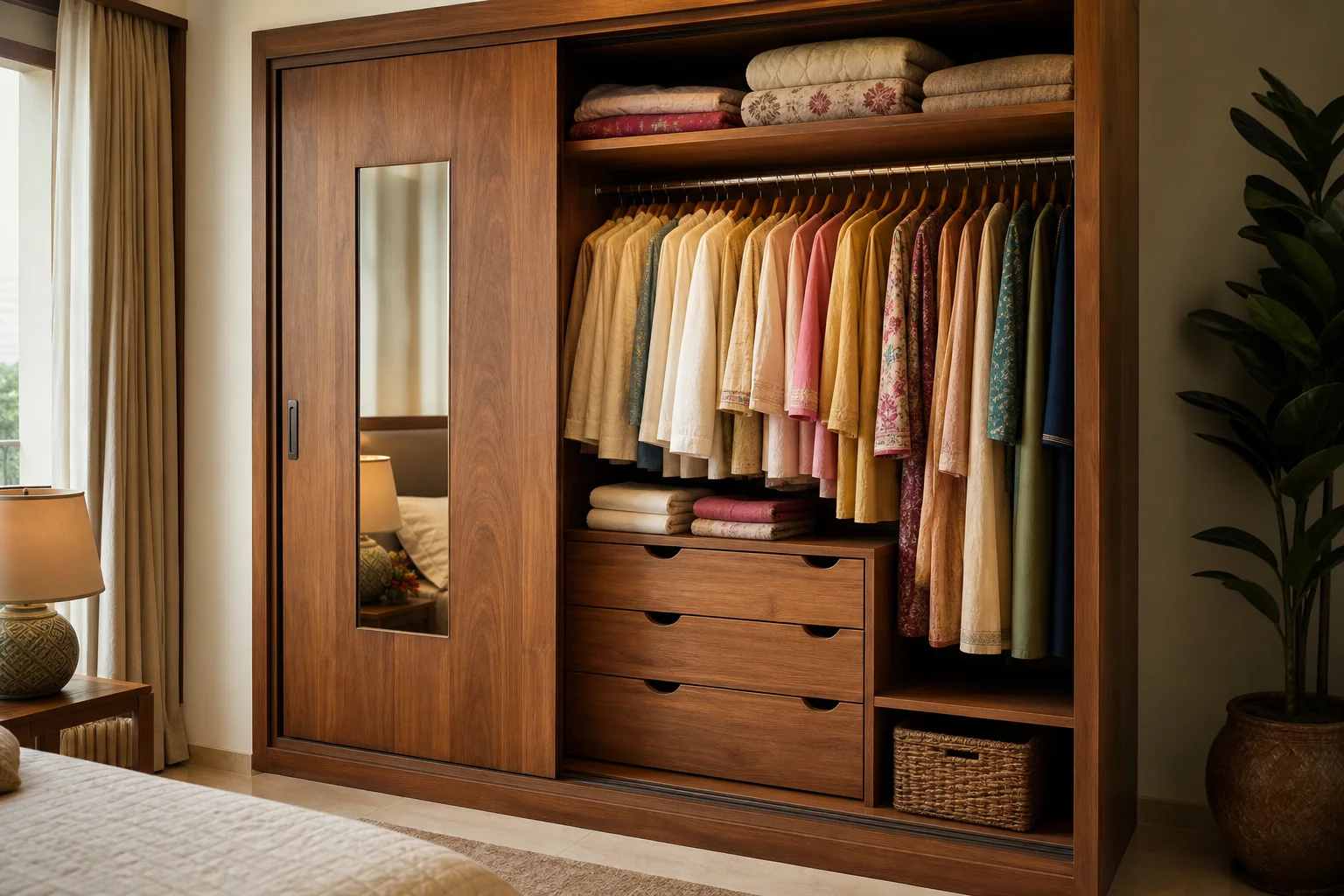
Sliding doors typically cost more than hinged doors because they need precision-fitted tracks and rollers that have to glide smoothly for years without jamming. Add-ons like built-in mirrors, jewelry drawers, locker compartments, pull-out trouser rods, and adjustable shelving each add to the base price, but they also add genuine daily convenience. Here’s a quick breakdown of how configuration choices typically stack cost:
- Door type: hinged doors are the most economical; sliding doors add cost for tracks and hardware; mirrored doors add further for glass and backing.
- Drawer count: each additional drawer needs its own runners, a drawer box, and a face panel, adding incremental cost.
- Shelving depth and adjustability: fixed shelves are cheaper than adjustable shelf systems with multiple peg positions.
- Locker or safe compartments: these need extra locking hardware and reinforced panels.
- Width and height: custom sizing for tall ceilings or unusually narrow rooms often carries a customization premium.
If your bedroom has limited floor space, it’s worth reading our guide on choosing safe wooden furniture for kids’ rooms for ideas on space-conscious, safety-first storage design that also applies to compact adult bedrooms.
Finish, Hardware, and Craftsmanship Costs
The visible finish on a wardrobe isn’t just about looks, it affects durability and price too. A natural oil or wax finish that lets the teak grain show through generally costs more in labor because it’s applied and buffed in multiple coats by hand. Laminate or veneer finishes are quicker and cheaper to apply but can chip or peel over time, especially at edges and corners that get frequent contact.
Joinery technique is another hidden cost factor. Traditional mortise-and-tenon or dovetail joints take longer to cut and assemble but create a far stronger structure than wardrobes held together mainly with nails, screws, and adhesive. You won’t see this difference in a product photo, but you’ll feel it within a year or two when a poorly joined wardrobe starts to wobble or the doors stop aligning.
Hardware quality rounds out this category. Soft-close hinges, branded drawer channels, and solid metal handles cost more than basic hardware, but they reduce daily wear and prevent the sagging drawers and squeaky doors that plague budget furniture. When comparing quotes, ask what brand of hinges and channels are used, a reputable D2C seller should list this detail on the product page.
A wardrobe’s price reflects not just the wood you can see, but the joinery, hardware, and finishing work you can’t see until years later, when it either holds up or falls apart.
Design Style and Customization Premiums
Style choice adds another layer to the final price. Colonial-style wardrobes with carved panels and paneled doors take more craftsmanship hours than a clean-lined minimalist design. Mid-century and Nordic-inspired styles often use simpler geometry but may call for specific hardware finishes or tapered legs that require extra machining. Carving, fluting, or inlay detailing on doors and frames adds labor cost proportional to how intricate the pattern is.
Custom sizing is another common premium. If your room has an alcove, a sloped ceiling, or an unusual width, a made-to-measure wardrobe avoids wasted space but typically costs more than a standard off-the-shelf size, since it can’t be batch-produced. If you’re furnishing a full bedroom and want matching pieces, it’s often more cost-effective to plan the wardrobe alongside other furniture rather than ordering pieces separately over time.
Regional Cost Factors for Bhopal and Other Indian Cities
Where you live also plays a role in what you’ll pay. In Bhopal, as in Indore, Bengaluru, Mumbai, and Pune, delivery logistics, local carpenter labor rates, and even climate considerations affect final pricing. Buying through an online D2C brand with established delivery routes to these cities often works out more predictable than negotiating with a local carpenter, whose pricing can vary widely based on demand and material sourcing that week.
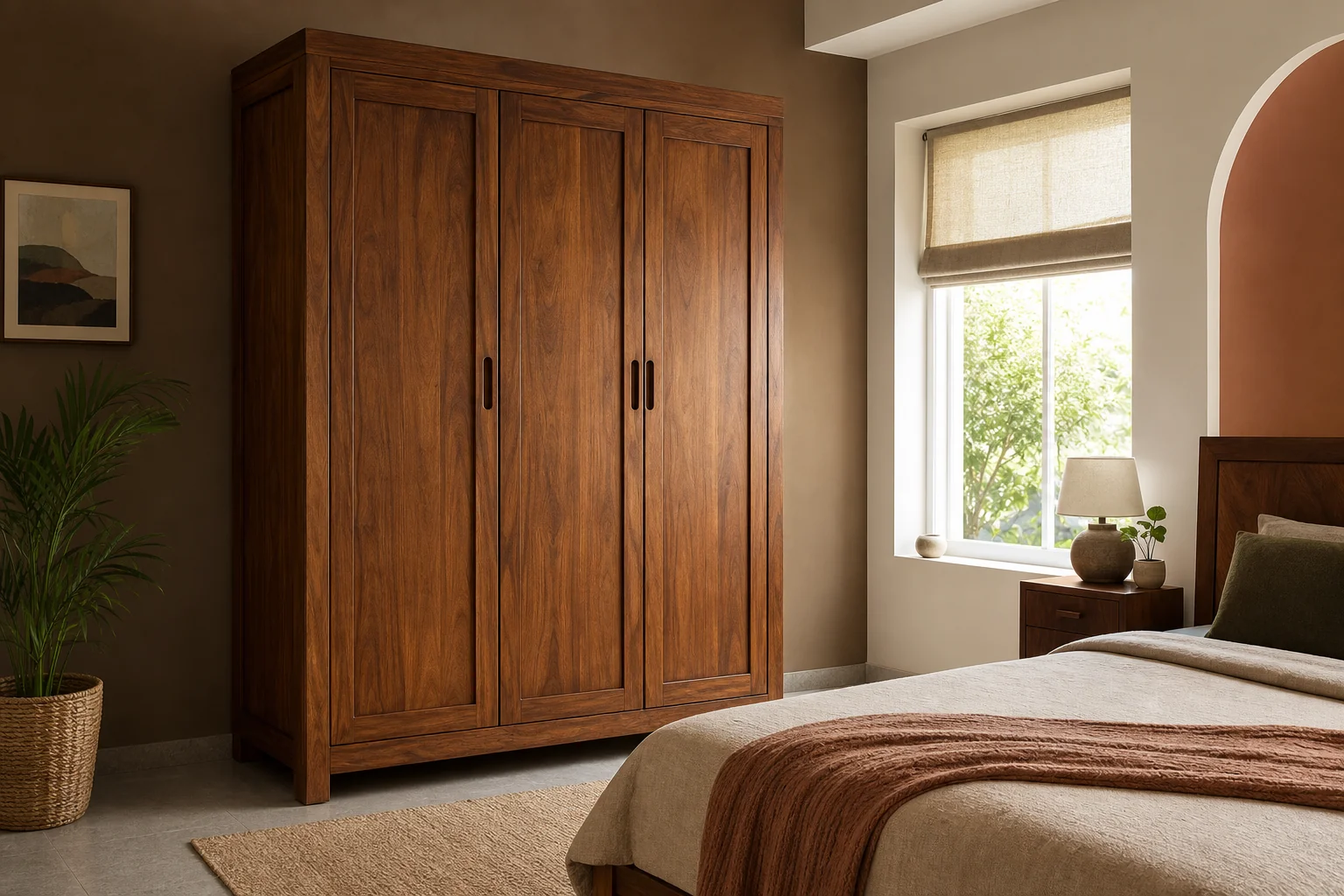
Central India’s climate, with hot, dry summers and a distinct monsoon season, makes moisture resistance especially important for Bhopal and Indore buyers. Wood that hasn’t been properly kiln-dried before construction can warp or crack as humidity swings through the year. This is one more reason solid, well-treated teak often works out cheaper over its lifetime than a lower-priced engineered alternative that needs replacing every few years.
According to the Directorate of Plant Protection, Quarantine & Storage, timber moisture content and treatment standards directly affect a wood product’s resistance to pests and decay in Indian conditions, a useful benchmark when you’re asking a seller about their drying process. For buyers comparing options across other markets, our guides on solid teak wood furniture in Bengaluru and buying teak furniture with delivery to Pune cover city-specific delivery and buying considerations that apply to wardrobes as well.
Budgeting Realistically: A Price Breakdown Framework
Instead of anchoring to a single number, it helps to think about wardrobe pricing as a stack of decisions, each adding a defined amount to your base cost:
- Start with material: decide between solid teak and engineered wood based on how long you expect to keep the piece.
- Factor in grade: plantation teak versus premium-grade heartwood shifts the per-unit cost meaningfully.
- Add size and configuration: more doors, drawers, and sliding mechanisms increase the total.
- Add finish and hardware quality: hand-applied natural finishes and branded hardware cost more but reduce future repair costs.
- Add style and customization: carved detailing or made-to-measure sizing adds a final premium layer.
Thinking in cost-per-year rather than upfront price alone often changes the decision. A solid teak wardrobe priced higher today but expected to last 20-25 years usually works out cheaper annually than an engineered wood piece that needs replacing every 5-7 years, especially once you factor in the disruption and cost of buying furniture repeatedly.
Before you order online, run through this quick checklist:
- Confirm the exact wood species and whether it’s solid or veneered.
- Ask about heartwood content and drying/treatment process.
- Check hinge and drawer channel brand or quality grade.
- Clarify what’s included: mirrors, locks, and adjustable shelving may be optional add-ons.
- Verify delivery timelines and assembly support for your city.
If you’re ready to compare configurations side by side, you can shop the collection to see solid teak wardrobe options across sizes and finishes, or use quick view on individual listings to check dimensions and materials before deciding.
Frequently Asked Questions About Solid Wood Wardrobe Pricing
Is a solid teak wardrobe worth the extra upfront cost?
For most households planning to keep furniture for a decade or more, yes. Solid teak resists moisture, pests, and structural sagging far better than engineered alternatives, which means fewer repairs and replacements over time. If you’re furnishing a rental or expect to move frequently within a couple of years, a mid-range engineered option may make more practical sense.
How much more does solid teak cost compared to engineered wood?
The gap varies by size, finish, and grade, but solid teak wardrobes generally sit well above engineered wood equivalents due to raw material and craftsmanship costs. Rather than quoting a fixed figure, it’s best to compare specific product listings, since configuration and finish can shift the price meaningfully within either category. Contact us or browse current listings for an accurate, up-to-date price comparison.
Can I customize wardrobe size without paying a huge premium?
Minor adjustments to height or depth are often manageable with a modest premium, since they don’t require a full redesign. Significant custom sizing for irregular rooms, however, typically costs more because it can’t be batch-manufactured. If your room has a standard layout, choosing from existing configurations usually keeps costs lower.
How do I verify wood quality before paying online?
Ask the seller for close-up photos of the grain, details on heartwood content, and information about their drying and treatment process. Genuine teak has a distinct grain pattern and feels notably heavier than engineered alternatives. For a step-by-step verification method, see our guide on checking real teak wood before buying furniture.
Do storage features like drawers and mirrors add significantly to the price?
Yes, each added feature, extra drawers, sliding mechanisms, or integrated mirrors, adds incremental cost because of the additional hardware and labor involved. Prioritize the features you’ll actually use daily rather than adding every available option, which keeps your budget focused on genuine value.
Choosing a wardrobe is a decision you’ll live with for years, not months. Once you understand the real solid wood wardrobe price factors, from teak grade and joinery to hardware and finish, you’re in a much stronger position to compare listings and avoid paying for hidden shortcuts. When you’re ready to see genuine solid teak options built for durability, shop the collection and compare configurations, or use add to basket once you’ve found the wardrobe that fits your space and budget.