Blog
Teak Wood Dining Table Price: 2026 Cost Guide
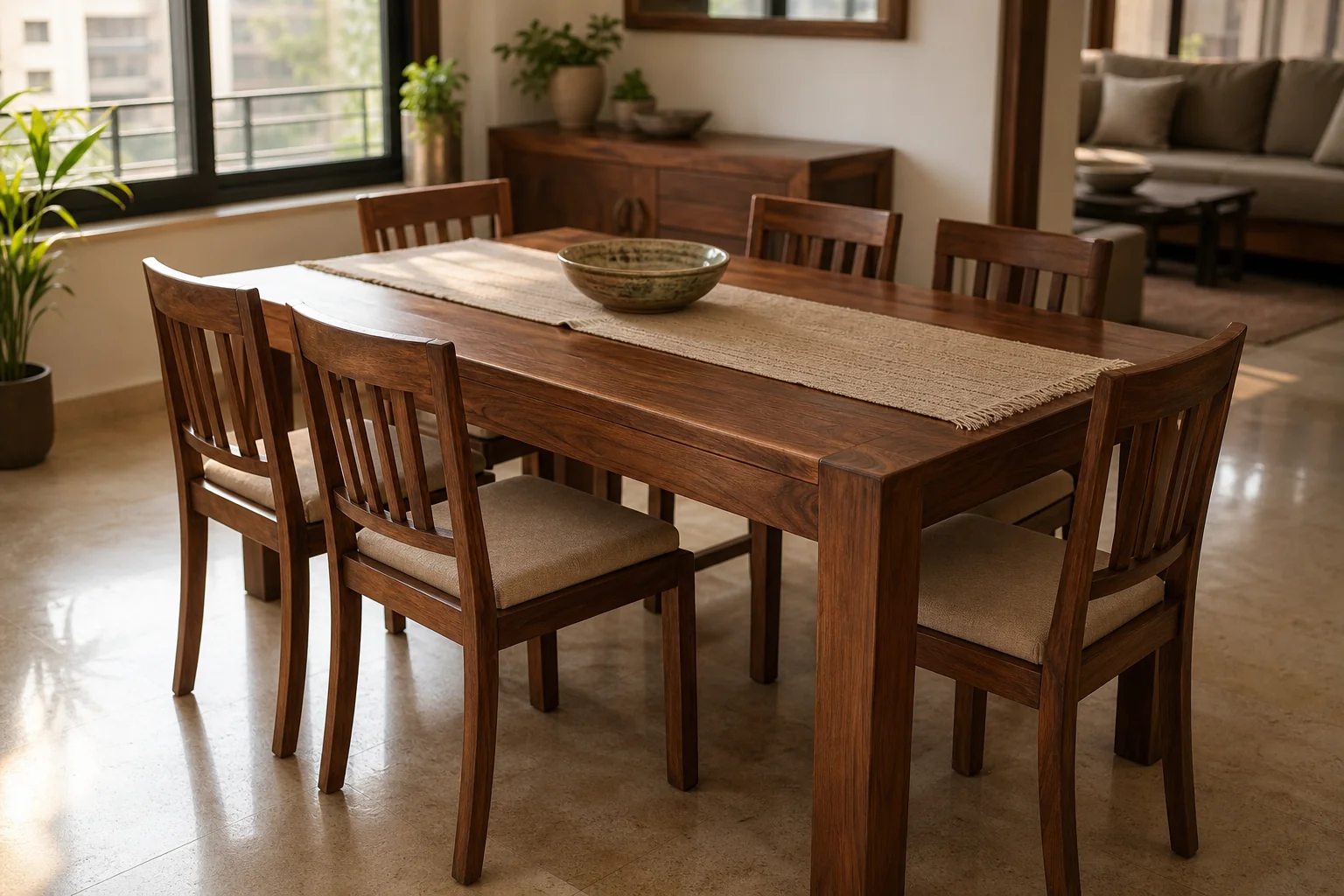
A Bhopal homeowner recently messaged three different online furniture stores asking one simple question: why does one 6-seater dining table cost ₹28,000 and another, which looks almost identical in photos, cost ₹68,000? None of the sellers gave her a straight answer. She ended up ordering the cheaper one, and within eight months the tabletop had warped near the edges where the humidity from her kitchen window hit it daily.
That story repeats itself across central India every month. Buyers in Bhopal, Indore, and nearby cities are shopping for furniture online more than ever, but most listings never explain what actually goes into a teak wood dining table price. This guide breaks down every cost factor, wood grade, joinery, size, finish, and design style, so you know exactly what you’re paying for before you check out.
What Really Decides a Teak Wood Dining Table Price
A teak dining table isn’t priced on wood alone. Five factors combine to set the final number: the grade of teak used, the joinery method holding it together, the size and seating capacity, the finish applied, and the design style you choose. Two tables can look nearly identical in a product photo and still differ by tens of thousands of rupees once you account for these variables.
This matters even more when you’re buying online, where you can’t run your hand across the tabletop or check how snug the joints feel. Shoppers in Bhopal, Indore, Bengaluru, Mumbai, and Pune are increasingly ordering dining sets sight unseen, based on photos and specs alone. Knowing what drives cost gives you a way to judge value without physically visiting a showroom. Let’s go factor by factor.
1. Wood Grade: Why Not All Teak Costs the Same
Teak isn’t a single uniform product. The wood’s age, growing conditions, and part of the tree used all change its density, oil content, and price. Old-growth teak, harvested from trees several decades old, has tighter grain and higher natural oil content, which makes it more resistant to moisture, pests, and warping. It costs more because mature trees take longer to grow and are harder to source sustainably.
Plantation-grown teak, typically 20 to 30 years old at harvest, is the most common type used in mid-range furniture today. It’s still genuine solid teak, just with slightly less density than old-growth timber. This is a fair, sustainable choice for most homes and the segment where solid teak wood furniture buyers typically get the best balance of price and durability.
Then there’s the confusing middle ground: tables marketed as “teak” that are actually engineered wood, MDF, or rubberwood with a teak veneer or teak-toned polish on top. These cost far less to produce, but they don’t share teak’s natural resistance to moisture and pests. If you’re weighing this trade-off, it helps to understand how solid teak compares against engineered alternatives before you commit to a purchase.
A quick way to check: ask the seller directly whether the table is solid teak throughout or teak veneer over a different core. Reputable D2C brands will state this clearly in the product description rather than using vague terms like “teak finish” or “teak look.”
2. Joinery and Construction: The Hidden Cost Driver
Wood grade gets most of the attention, but joinery is often the bigger hidden factor in a teak wood dining table price. Mortise-and-tenon joints, where one piece of wood is carved to fit precisely into a slot in another, are the gold standard. They’re labor-intensive, require skilled hands, and hold up for decades without loosening. Furniture built this way costs more because it takes longer to make and needs experienced carpenters.
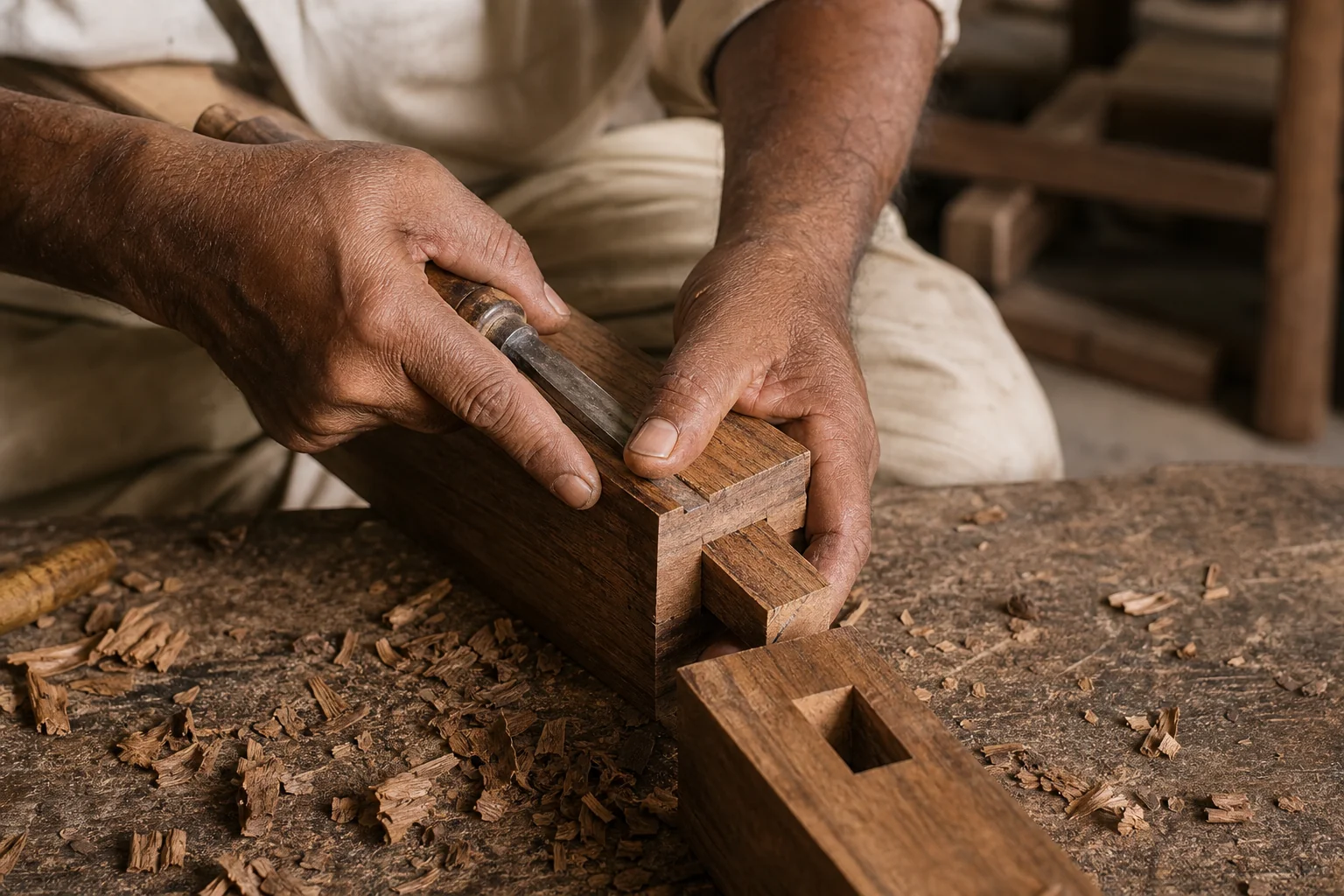
Cheaper tables often rely on dowel joints or screw-and-glue construction. These are faster to assemble and cut labor costs significantly, but they tend to loosen over time, especially under the stress of daily use, chairs being pulled in and out, elbows leaning on the edge, kids climbing on and off.
This matters even more in cities like Bhopal, where summers are dry and monsoons bring sharp humidity swings. Wood expands and contracts with moisture changes, and weak joinery is the first thing to fail. A well-joined table flexes with these seasonal shifts. A poorly joined one starts wobbling within a year or two. When you’re comparing prices online, ask whether the listing mentions joint type. If it doesn’t, that silence is often the answer.
3. Table Size and Seating Capacity
Seating capacity is the most obvious price driver, but it doesn’t scale in a straight line. A 4-seater table naturally uses less timber than an 8-seater, but labor, finishing time, and structural bracing also increase with size, so larger tables cost proportionally more, not just linearly more.
- 4-seater tables suit compact apartments and are the most budget-friendly option, ideal for smaller Bhopal flats or starter homes.
- 6-seater tables are the most popular size for mid-sized independent houses and are where most buyers land when balancing space and entertaining needs.
- 8-seater and extendable tables command the highest prices due to the extra timber, additional support legs or aprons, and the engineering needed for extension mechanisms.
If you regularly host guests but don’t have permanent space for a large table, an extendable design is worth the added cost. These use a leaf-insertion mechanism or folding drop-leaf system, both of which require precise craftsmanship, which is reflected in the price. Before buying, measure your dining area and allow at least 90 cm of clearance on each side for chairs to pull out comfortably.
4. Finish Type and Protective Coating
The finish on a teak dining table affects both its look and its price. A natural oil finish highlights the wood’s grain and ages gracefully, but it requires periodic reapplication to stay protective, adding a small ongoing maintenance cost that many buyers don’t anticipate.
A matte or satin lacquer finish offers a smoother, low-maintenance surface with decent resistance to water rings and everyday spills, sitting in the middle of the price range. High-gloss polyurethane finishes tend to cost more upfront because of the multiple coating and buffing stages involved, and they offer strong protection against moisture and stains, useful in humid kitchens or homes near water bodies.
Whichever finish you choose, proper care extends the table’s life significantly. If you already own teak furniture, our guide on how to maintain teak wood furniture at home covers cleaning routines and oiling schedules that keep the finish looking new for years.
5. Design Style: Modern, Colonial, and Mid-Century Pricing Differences
Design style changes the amount of labor and detailing that goes into a table, which shows up directly in the final price.
Modern minimalist tables use clean lines, simple tapered or block legs, and minimal ornamentation. They’re generally the most affordable style because they require less hand-carving and detailing time, while still showcasing the wood’s natural grain.
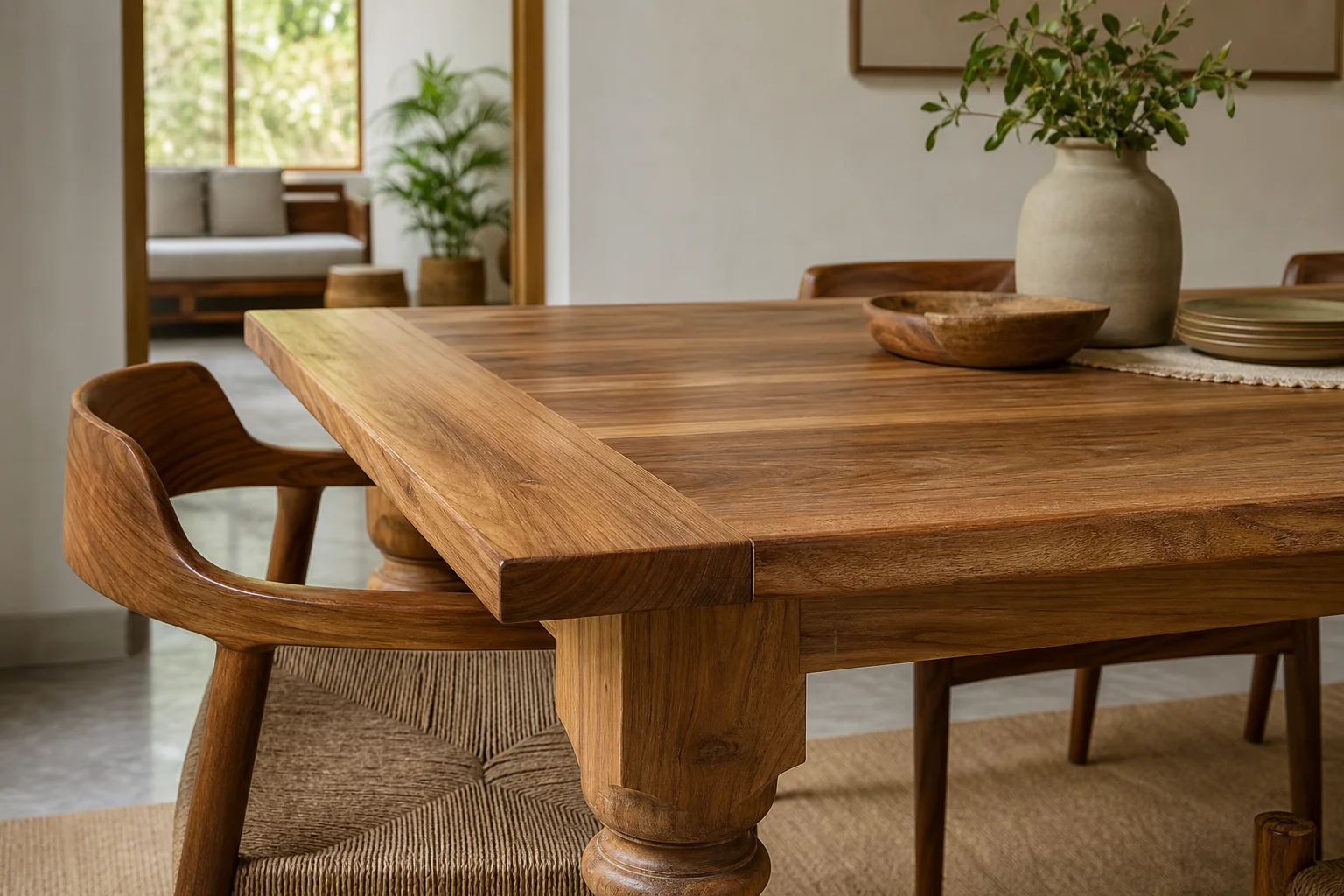
Colonial style tables feature heavier proportions, carved legs, turned details, and sometimes brass or metal accents. These use more timber overall and require significantly more hand-finishing, pushing them toward the higher end of the price spectrum.
Mid-century designs sit in between, characterized by tapered angled legs, subtle curves, and a focus on joinery visibility as a design feature rather than something to hide. The specialty joints and precise angles needed for authentic mid-century pieces mean moderate to high pricing, depending on the complexity of the leg and apron work.
TeakLab’s curated collections, including Nordic, American Dawn, Mid-Century, and Colonial lines, are built around these exact style categories, so you can compare price differences within a consistent quality standard rather than guessing across unrelated brands.
Teak Wood Dining Table Price: Budget Planning Table
Here’s a realistic breakdown of what to expect at each price tier when shopping online in 2026. These bands reflect solid teak construction, not veneer or engineered wood substitutes marketed as teak.
| Price Tier | Typical Seating | Wood Grade | Joinery | Finish | What to Expect |
|---|---|---|---|---|---|
| Entry (₹20,000–₹40,000) | 4-seater | Plantation teak, sometimes mixed with teak veneer on non-visible parts | Dowel or screw-and-glue joints | Basic lacquer or matte polish | Good for compact spaces and light daily use; verify solid wood claims carefully |
| Mid-Range (₹40,000–₹80,000) | 6-seater | Solid plantation teak throughout | Partial mortise-and-tenon with reinforced joints | Satin lacquer or semi-gloss | Best value zone; suits most families and daily entertaining needs |
| Premium (₹80,000–₹1,50,000+) | 8-seater or extendable | Old-growth or select-grade solid teak | Full traditional mortise-and-tenon joinery | Hand-rubbed natural oil or premium polyurethane | Heirloom quality, built to last generations with proper care |
Prices above are indicative ranges for solid teak dining tables sold through Indian D2C furniture brands as of 2026 and can vary based on customization, delivery location, and design complexity. Always confirm current pricing directly with the seller before ordering, since raw material costs and exchange rates shift throughout the year.
How to Spot Real Quality vs an Overpriced or Poorly Sourced Table
Price alone doesn’t guarantee quality, and a high price doesn’t always mean better craftsmanship. Here’s how to verify what you’re actually paying for:
- Check the grain pattern in photos. Genuine teak has a straight, consistent grain with a slightly oily sheen, not a flat, uniform pattern that repeats, which often signals veneer or printed laminate.
- Ask about weight. Solid teak is noticeably heavier than engineered wood or softwood alternatives. If a seller can’t tell you the approximate weight, that’s worth a follow-up question.
- Look for joinery details in the description. Listings that specify “mortise-and-tenon joinery” or “traditional joinery” are being transparent. Vague phrases like “sturdy construction” without specifics deserve scrutiny.
- Verify sourcing claims. Reputable sellers can explain where their teak comes from and whether it’s sustainably harvested. Vague sustainability claims without any sourcing detail are a red flag.
- Compare against known reference points. If a table is priced far below the entry-range figures in the table above for a claimed solid teak 6-seater, question what’s been substituted to hit that price.
For a deeper walkthrough on inspecting wood before you buy, see our guide on how to check real teak wood before buying furniture, which covers grain, smell, and finish tests you can apply to any listing, not just dining tables.
Teak Dining Tables for Bhopal Homes and Beyond
Buyers in Bhopal and Indore face a specific challenge: fewer dedicated solid-wood furniture showrooms compared to metro cities, which pushes many households toward online ordering. This makes transparent specifications even more important, since you’re trusting photos and product descriptions rather than physically inspecting the piece.
Madhya Pradesh’s climate adds another layer to consider. Summers run hot and dry, while the monsoon months bring sharp humidity spikes. Solid teak handles this seasonal swing far better than engineered wood alternatives, thanks to its natural oil content, which resists moisture absorption and reduces warping risk. This is one reason solid teak remains the safer long-term investment for homes across central India, and for buyers in Karnataka, Maharashtra, and other states within TeakLab’s delivery network as well.
When ordering online for delivery to Bhopal or nearby cities, confirm the estimated delivery timeline, packaging protection, and whether assembly support is included. A well-packed solid teak table should arrive with corner protection and moisture-resistant wrapping, especially important if your order is shipped during monsoon months.
Frequently Asked Questions
What is a fair price for a 6-seater teak dining table in India?
As of 2026, a solid teak 6-seater dining table typically falls between ₹40,000 and ₹80,000, depending on joinery quality, finish, and design style. Anything significantly below this range for a claimed solid teak piece warrants a closer look at the wood grade and construction details.
Is engineered wood cheaper but worth it for a dining table?
Engineered wood costs less upfront and can work for short-term or budget-constrained needs, but it generally doesn’t match solid teak’s resistance to moisture, warping, and daily wear. For a piece you plan to keep for many years, especially in a humid climate, solid teak tends to offer better long-term value despite the higher initial cost.
How long should a solid teak dining table last?
With proper care, a well-built solid teak dining table can last several decades, often becoming a piece passed down across generations. Longevity depends heavily on joinery quality and how consistently the finish is maintained over the years.
Does design style affect resale or long-term value?
Classic styles like colonial and mid-century tend to hold their appeal longer than trend-driven designs, partly because they’re built with heavier timber and more detailed joinery. Modern minimalist pieces remain popular too, but their value is more tied to build quality than styling trends.
A dining table isn’t just a purchase, it’s where meals, conversations, and family milestones happen for years. Paying for the right wood grade and joinery upfront costs far less than replacing a table that fails within a few seasons.
If you’re ready to compare real specifications instead of guessing from vague listings, explore TeakLab’s dining collection to see wood grade, joinery type, and finish details laid out clearly for every table. You can shop the collection to compare sizes and styles side by side, use quick view to check construction details on any piece that catches your eye, or select options to match a table to your seating needs and dining room dimensions. Once you’ve found the right fit, you can add it to your basket and get a genuine solid teak dining table delivered to your Bhopal home with confidence in what you’re actually paying for.