Blog
How to Choose a Storage Bed That Fits Your Room
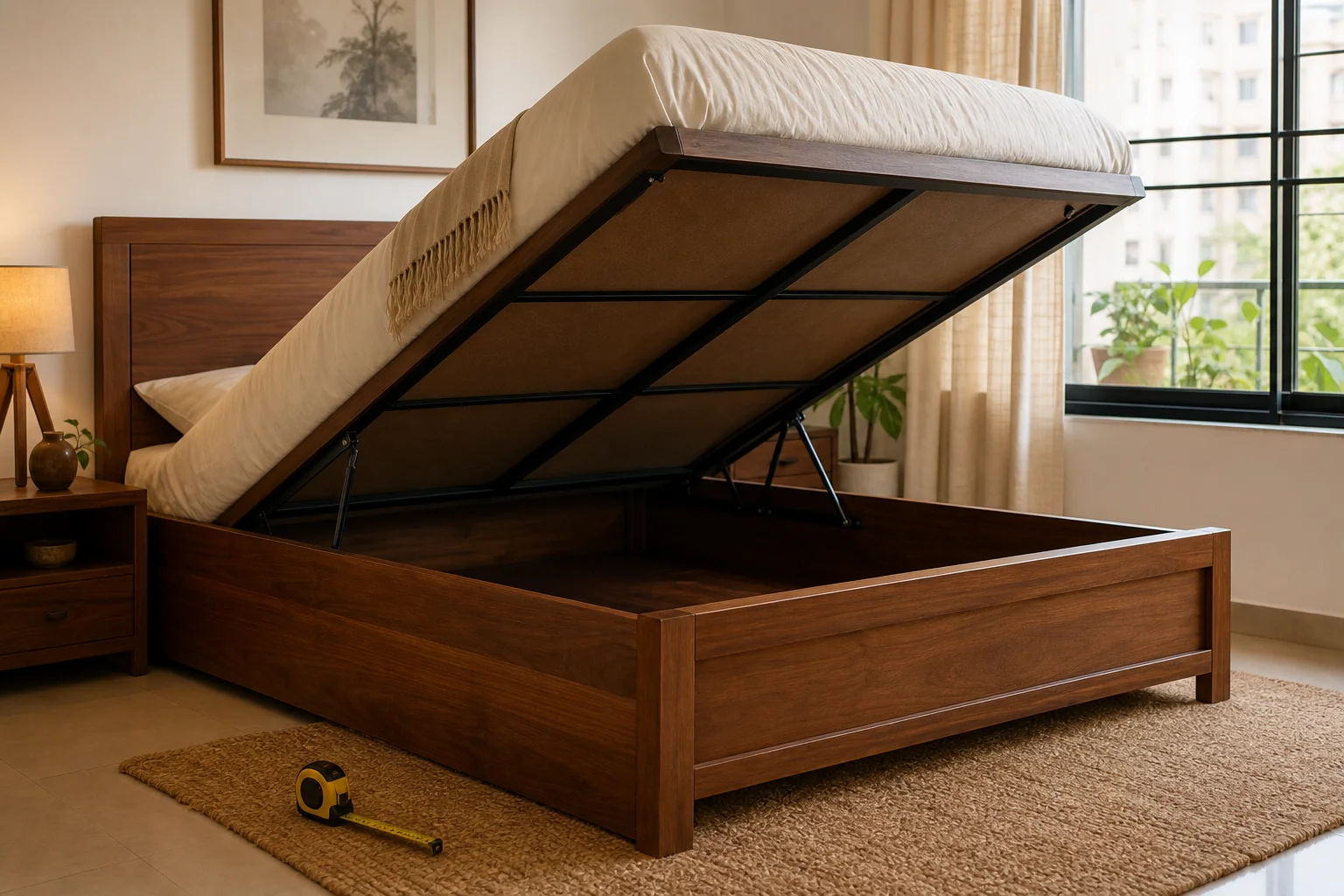
Pick a storage bed based on three things, in this order: how much clearance your room actually has, whether hydraulic lift or drawer storage fits your daily routine, and whether the frame is built on a solid wood core instead of laminated particle board. Get those three right and the rest, finish, hardware, mattress fit, falls into place. Get them wrong and you end up with a bed that groans under its own storage lid within a year.
Key Takeaways
- Measure before you shop: hydraulic storage beds need roughly 12-15 inches of lift clearance plus space to swing the mattress base up; drawer beds need floor clearance in front of the frame instead.
- Hydraulic vs drawer isn’t cosmetic: hydraulic gives full-length access for bulky, rarely-used items; drawers suit things you pull out weekly, like linens or kids’ clothes.
- The wood core matters more than the finish: a laminate photo can’t tell you if the bed is solid teak or particle board underneath, and particle board sags under sustained storage weight.
- Hardware is where cheap beds fail first: thin hinges and single-point struts are the top reason storage beds get returned or repaired within 18 months.
- Solid teak resists humidity swings common across Indian cities better than engineered wood, which matters directly for how long the storage mechanism stays aligned.
Storage Bed Selection At a Glance
| Factor | Hydraulic Storage Bed | Drawer Storage Bed |
|---|---|---|
| Access | Full mattress-length, lift entire base | Partial, pull-out drawers on sides or foot |
| Best for | Bulky, seasonal items (quilts, luggage) | Daily-use items (linens, kids’ clothes) |
| Clearance needed | 12-15 inches overhead lift space | Floor clearance in front of drawers |
| Wood core to look for | Solid teak or hardwood frame with rated struts | Solid wood runners, not just laminated panels |
| Common failure point | Weak hydraulic struts, single hinge point | Cheap metal runners bending under load |
| Ideal room type | Small bedrooms needing maximum hidden storage | Rooms with easy floor access, frequent use |
| Maintenance | Occasional strut lubrication check | Runner cleaning, no lubrication usually needed |
1. Start With Your Room’s Actual Dimensions
Most people shop for a storage bed the way they shop for a phone case: by looks first, dimensions later. That order causes the most common complaint we hear from buyers in Bhopal and Indore, where bedroom sizes in newer apartments often run smaller than older independent houses. A queen storage bed that looks compact in a showroom photo can eat up nearly a third of a 10×10 room once you add walking space around it.
Before you fall for a design, walk into the room with a tape measure. For a hydraulic lift bed, you need enough vertical clearance above the mattress, usually 12 to 15 inches, for the base to swing open without hitting a low ceiling fan, wall-mounted shelf, or sloped ceiling. You also need side clearance so the mattress doesn’t scrape a wardrobe or window sill when it’s lifted at an angle.
Drawer-style beds work differently. They don’t need overhead clearance, but they do need open floor space in front of the frame, usually at least 24 inches, so the drawers can slide out fully. If your bed sits against a wall with limited walking space on one side, check which side the drawers open from before you order.
- Single/twin beds: good for kids’ rooms or guest rooms; storage volume is modest but useful for seasonal linens.
- Queen beds: the most common choice for couples; offers the best storage-to-footprint ratio for a standard Indian bedroom.
- King beds: maximum storage but needs a room at least 11×12 feet to leave comfortable walking space.
If you’re furnishing a smaller home and want the same discipline applied to seating, our guide on choosing safe wooden furniture for kids’ rooms covers similar clearance and safety math for children’s spaces, which often shares a wall with a compact storage bed setup.
2. Decide Between Hydraulic Lift and Drawer Storage
This is the decision that shapes how you’ll actually live with the bed, not just how it looks in a listing. Hydraulic storage beds use gas struts to lift the entire mattress platform, exposing one large storage cavity underneath. That single cavity is great for bulky, infrequently used items: spare quilts, suitcases, off-season clothing, or a spare mattress for guests.
The tradeoff is access speed. You can’t get to your storage without first moving whatever is on the bed, pillows, a laptop, a sleeping toddler, and then lifting the entire base. For families who need to grab something from under the bed every day, that friction gets old fast.
Drawer beds solve that problem by trading total volume for convenience. Two or three drawers, usually mounted on the sides or at the foot of the bed, let you pull out exactly what you need without touching the mattress. They hold less overall, and the drawer runners themselves become a wear point if they’re made from thin stamped metal instead of solid wood glides.
A simple rule: if you’re storing things you touch weekly, choose drawers. If you’re storing things you touch seasonally, hydraulic lift storage wins on sheer volume.
Some hybrid designs combine a hydraulic base with one or two front drawers, giving you both quick access and bulk storage. These cost more to engineer well, so check the strut rating and drawer runner quality carefully, since manufacturers sometimes cut corners on one system to keep the other functional.
3. Check the Wood Core, Not Just the Finish
Here’s the part that trips up most online furniture buyers, including ones we talk to across Bengaluru, Mumbai, and Pune. A product photo shows you the finish: the color, the grain pattern, the hardware. It almost never shows you what’s structurally holding up the bed once you pile storage weight into it. That’s usually plywood, MDF, or particle board dressed up with a wood-toned laminate, and it behaves very differently from solid wood under sustained load.
Engineered wood cores flex and eventually sag when storage cavities are packed with heavy linens or luggage over months. In humid regions, and most Indian cities see significant humidity swings across the year, particle board also absorbs moisture at the edges, causing the storage lid or drawer fronts to warp slightly out of alignment. That’s often the real reason a “brand new” storage bed starts sticking or creaking within a year.
Solid teak behaves differently because of its natural oil content and dense grain structure, which resists moisture absorption and keeps its shape under load far better than engineered alternatives. It’s the same reason teak has been the default choice for boat decks and outdoor furniture for generations, not just bedroom frames. If you want to understand exactly how to verify real teak before you buy, our detailed breakdown on how to check real teak wood before buying furniture walks through the grain, weight, and smell tests sellers can’t fake in photos.
When you’re comparing options, ask the seller directly: is the frame solid wood throughout, or solid wood with an engineered wood panel for the storage base? Many “solid wood” listings only use solid wood for visible legs and rails, while the actual storage box is particle board. That distinction alone can explain a large price gap between two beds that look nearly identical online. For a deeper cost comparison between the two material categories, see our guide on teak wood vs engineered wood furniture.
4. Match the Storage Bed to Your Mattress and Sleep Setup
A storage bed’s mechanism has to work with your mattress, not against it. If you’re set on a hydraulic lift design, measure your mattress thickness first. Thicker mattresses, especially memory foam models over 8 inches, add extra bulk that can reduce your usable lift clearance or make the base harder to swing open in a low-ceiling room.
Solid slatted bases, common on well-built teak frames, allow better airflow underneath the mattress, which matters for foam mattresses that need ventilation to avoid moisture buildup. Solid platform bases without slats tend to trap heat and moisture, which can shorten the life of certain mattress types.
Standard Indian mattress sizes, single (72×36 inches), queen (78×60 inches), and king (78×72 inches), fit most manufactured storage beds without adjustment. If you already own a non-standard mattress or plan to buy a specific brand, confirm the internal frame dimensions before ordering rather than assuming a “queen” label matches your exact mattress. Custom sizing is worth asking about if your room has an unusual footprint or you’re combining a storage bed with a headboard-mounted study nook.
5. Inspect Hardware: Hinges, Struts, and Joinery
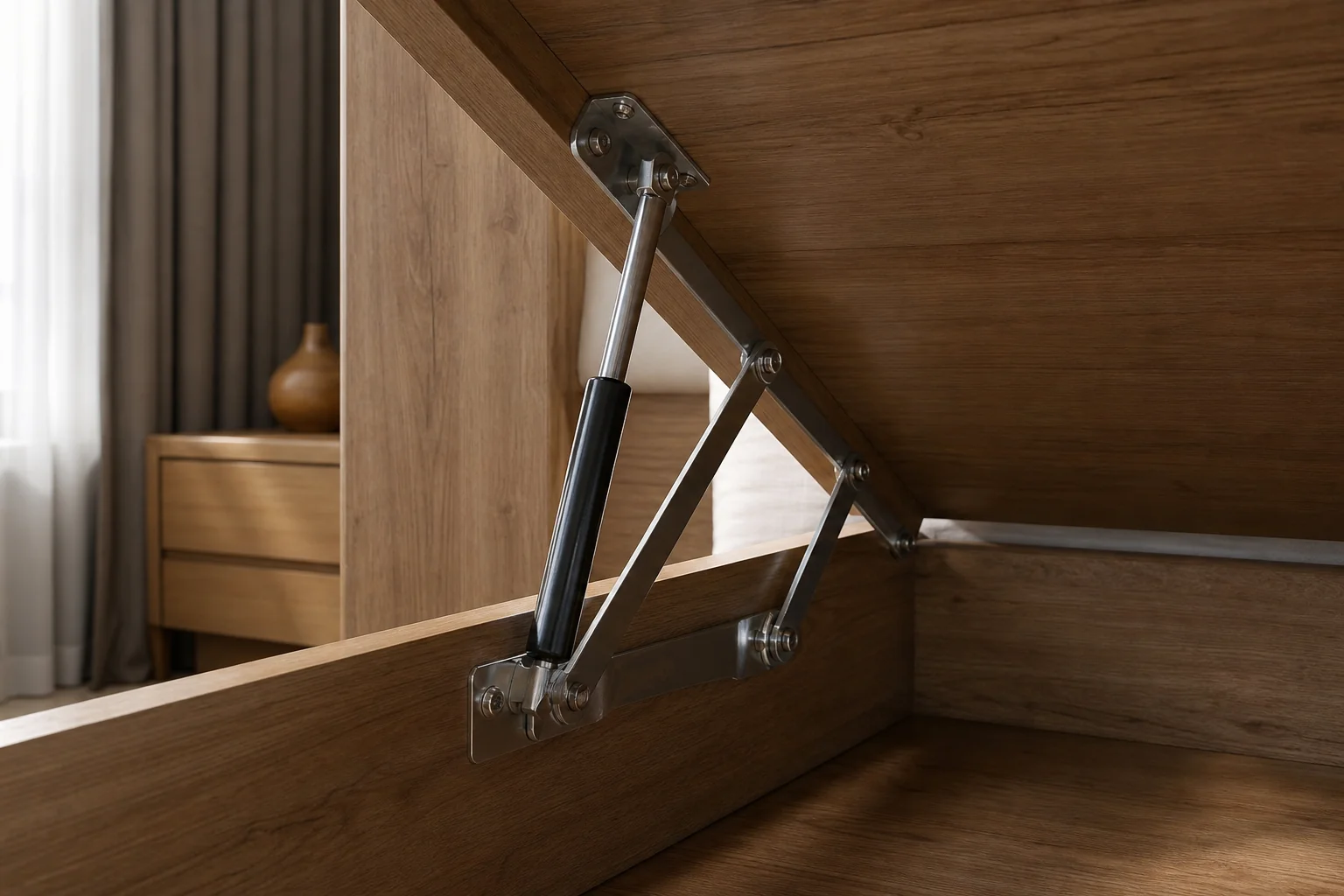
Wood quality gets most of the attention in furniture shopping, but hardware failure is what actually breaks most storage beds. A single-point hinge holding up a queen-size mattress base, instead of a reinforced double-hinge system, is a common shortcut on budget models. Under repeated daily lifting, that single hinge point wears out the surrounding wood socket, and eventually the whole lid stops closing flush.
Hydraulic struts have their own quality tiers. Look for struts with a stated weight rating, ideally soft-close or slow-release action rather than struts that slam down if you let go too early. Cheap struts lose pressure within a year or two and stop holding the lid open on their own, which becomes a real safety issue if the base can fall unexpectedly while someone’s reaching underneath.
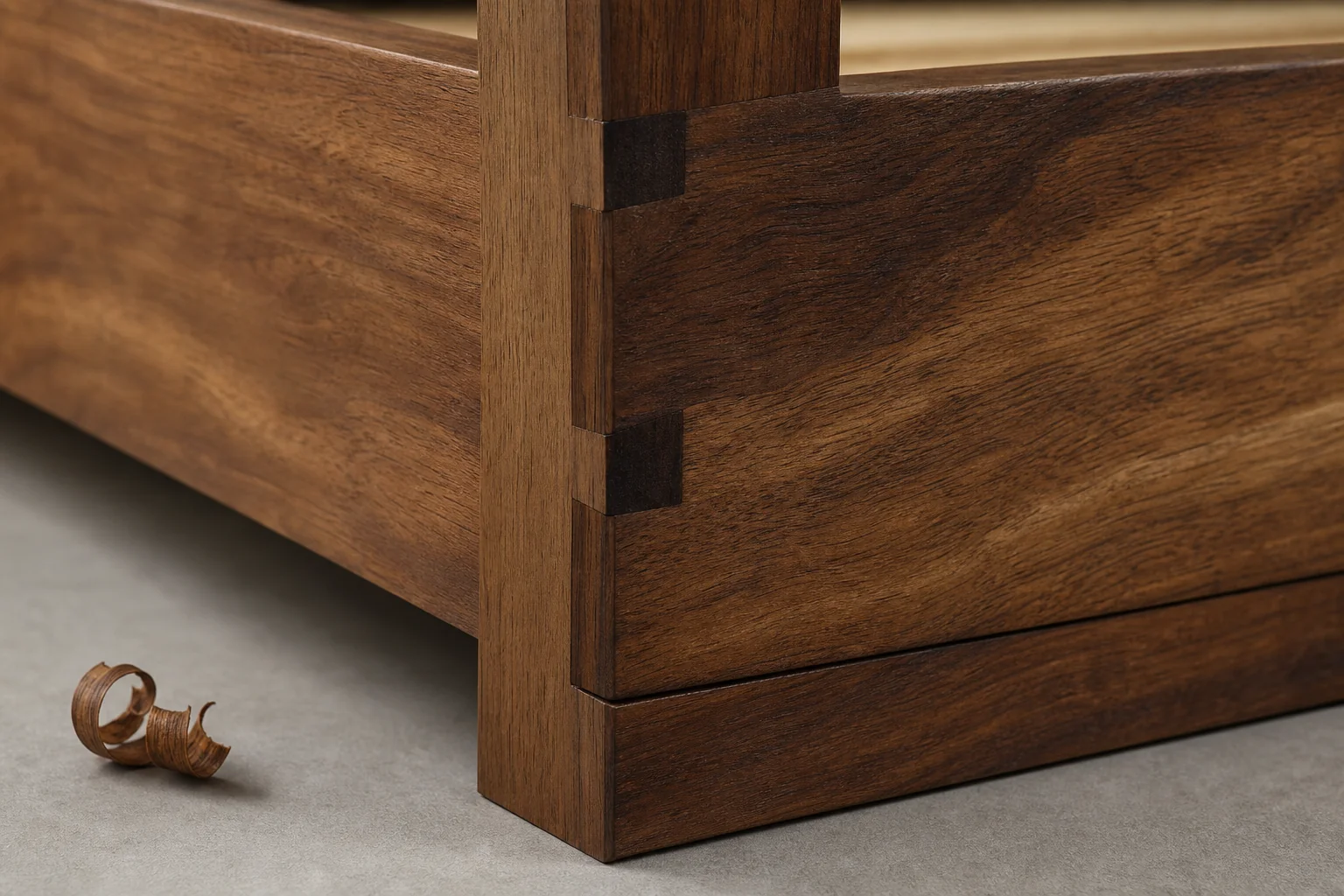
Joinery matters just as much for drawer-style beds. Traditional mortise-and-tenon or dovetail joints, common in handcrafted solid wood furniture, distribute stress across a wider wood surface than stapled or glued butt joints. Staples and thin glue joints are a clear red flag, especially at corners that bear repeated weight from someone sitting on the bed edge.
Before you buy, ask these questions:
- What is the hinge or strut weight rating, and is it warrantied separately from the wood frame?
- Are drawer runners metal ball-bearing glides or basic plastic tracks?
- Is the joinery visible in product photos, or only described in text?
- Does the seller offer a written warranty period, and what exactly does it cover?
A seller confident in their hardware will answer all four without hesitation. Vague answers, or a warranty that only covers “manufacturing defects” without specifics, are worth treating as a warning sign.
6. Think About Long-Term Durability and Maintenance
A storage bed is not a five-year purchase for most families; it’s meant to outlast at least one or two mattress replacements and, ideally, get handed down or resold in good condition. That long timeline is where the wood core decision from earlier really shows its value. Engineered wood cores generally hold up fine for the first couple of years, then start showing swelling at joints, especially in coastal or monsoon-heavy cities, and sagging in the storage base itself.
Solid teak needs very little upkeep to stay structurally sound for decades. A light wipe-down, occasional oiling, and keeping it away from direct standing water are usually enough. Our full walkthrough on how to maintain teak wood furniture at home covers the specific routine, including how often to oil the wood and what cleaning products to avoid.
There’s also a resale angle worth considering. Solid wood furniture, particularly teak, tends to hold resale value far better than engineered wood pieces, which usually lose most of their value once assembled and used. If you’re the type of buyer who upgrades bedroom furniture as your family grows, that difference adds up.
7. Where TeakLab’s Storage Beds Fit In
TeakLab builds its storage beds around the same principle this whole guide is built on: the wood core and hardware decide how long the piece actually lasts, not the finish photo. Every storage bed uses a solid teak frame, not a laminated panel dressed to look like one, paired with reinforced hydraulic struts rated for sustained daily use. Joinery follows traditional mortise-and-tenon techniques at stress points, the same detail we’d tell you to check for on any bed regardless of who made it.
These beds ship to homes across our full service area, including Bhopal, Indore, Bengaluru, Mumbai, and Pune, with designs spanning minimalist modern frames to colonial-style headboards for buyers who want storage without giving up on look. If you’ve already compared solid teak against engineered wood options in the market, our Bengaluru buyer’s guide to solid teak furniture is a useful companion read, since much of the sourcing and quality-check logic carries over city to city.
If you’re ready to see the storage bed options directly, you can Shop the Collection and compare hydraulic and drawer models side by side, or use Quick view on any listing to check dimensions and storage capacity before deciding. Once you’ve found the size and mechanism that fits your room, Select options for your preferred finish and mattress size, and Add to basket when you’re ready to move forward.
Frequently Asked Questions
Is hydraulic or drawer storage better for a small bedroom?
Hydraulic storage usually wins on raw capacity for small rooms since it uses the entire under-mattress cavity as one space, rather than splitting storage across drawer boxes with their own frames and runners. If your room is tight on floor space in front of the bed, hydraulic also avoids the need for drawer-opening clearance.
Can a solid teak storage bed handle heavy storage loads?
Yes. Solid teak’s dense grain structure and natural strength make it well suited to sustained storage weight, unlike particle board cores that flex and sag over time. The hardware, hinges or struts, still needs to be rated appropriately, since even a strong wood frame depends on quality hinges to support the lifted base.
How much storage space does a queen-size storage bed offer?
A queen hydraulic storage bed typically offers a cavity close to the full mattress footprint, roughly 60×78 inches, at a depth of 10 to 14 inches depending on the frame design. That’s usually enough for several folded quilts, spare pillows, and a couple of storage boxes.
Do storage beds need a special type of mattress?
No special mattress is required, but the base type matters. Slatted platforms suit most foam and hybrid mattresses well, since they allow airflow. If you own a very thick mattress, confirm the hydraulic lift clearance before buying to avoid it scraping against a low ceiling or wall unit when opened.
What’s the biggest mistake buyers make when choosing a multifunctional storage bed?
Buying based on the finish photo without confirming the wood core and hardware rating. A bed can look identical to a premium model in pictures while using particle board underneath and a single weak hinge, which is exactly why checking construction details before ordering matters more than the design itself.
Choosing a storage bed comes down to matching your room’s real dimensions, your daily storage habits, and the wood and hardware quality standing behind the design. Skip that homework and you risk a bed that looks right for a season and fails quietly within a year. Do it properly, with a solid teak frame and rated hardware, and you get a piece that holds up through years of daily use across humid summers and busy households alike. Browse TeakLab’s storage bed range, compare hydraulic and drawer models with Quick view, and Add to basket once you’ve found the frame that fits your room and your family’s routine.